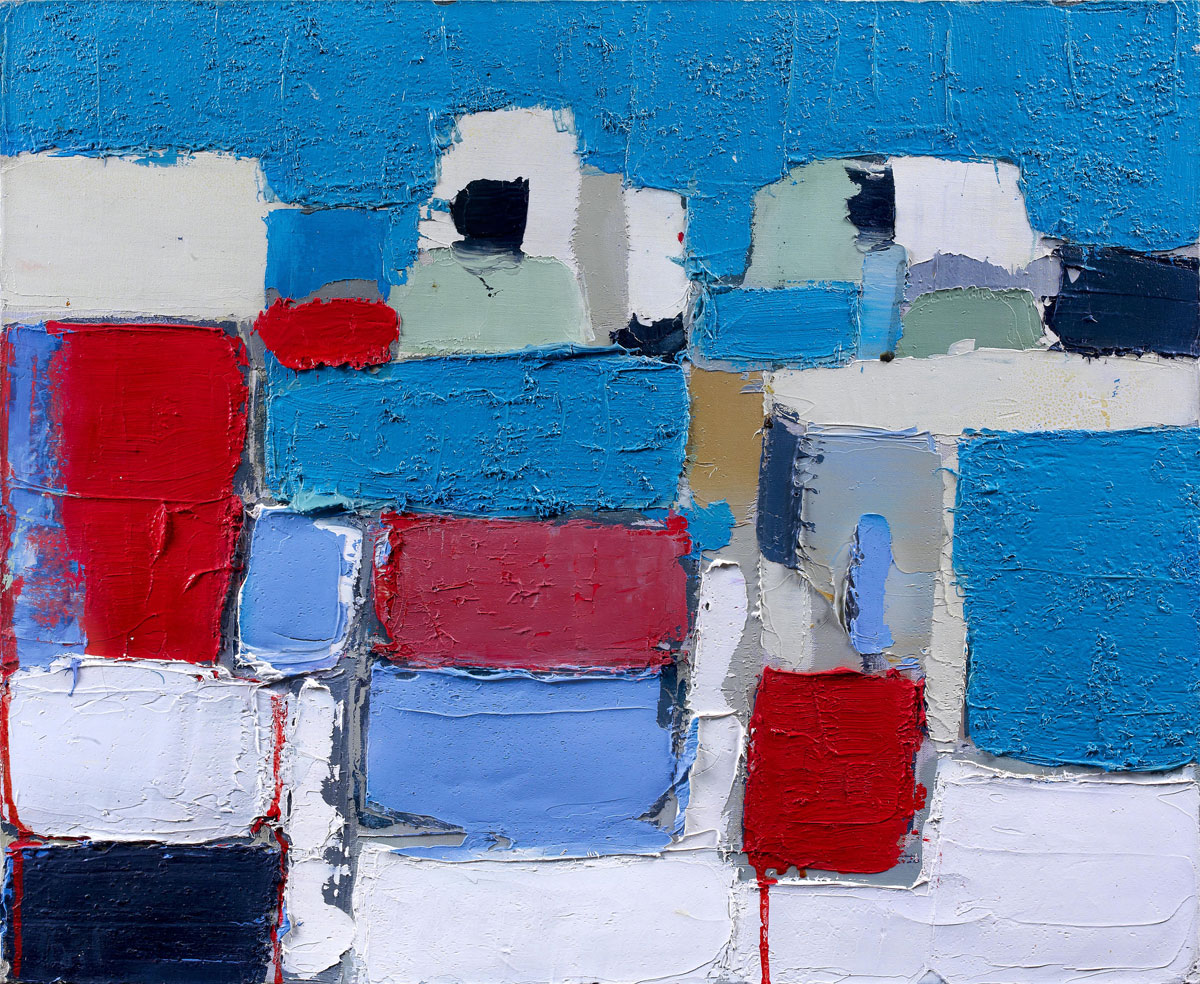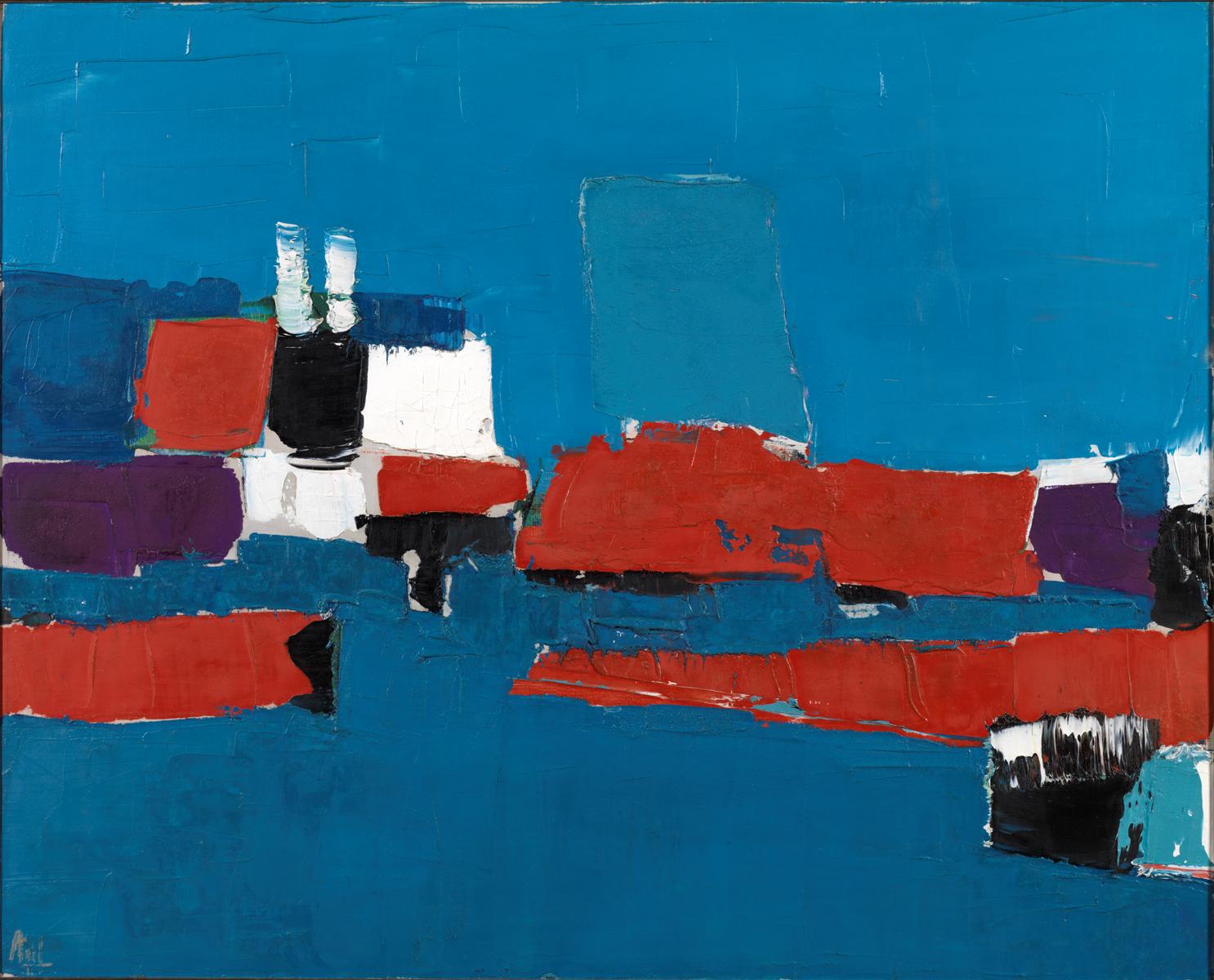
Nicolas de Staël – Mediterranée, Le Lavandou 1952
You can’t see the course of your life
I remember that summer evening when, with the susurrus of the sea close by, I listened to the deeply lined old man as he spoke. My teenage eyes detailed the shape of his wrinkles, sliding from one to the next, viewing them as proofs of fruitful efforts, as you would furrows by a plough in the earth.
His words came out in the salty muggy air slowly but with precision, and the ideas they shaped organised themselves before my eyes into geometric figures, clear over their blue background. His sayings were straight and simple, like the wakes of trawlers on the way back.
I felt as though I was in front of a blurred image which, by listening to the sailor, became clear and then, in the same unpredictable fashion, turned blurry again. I was grappling with obvious facts, things once known scattered into the very depths of my memory but, without that conversation, out of reach for me.
The inexplicable connection between his speech and my thoughts, triggering optical revelations of a kind that is short-lived and involuntary, happened to be rather similar to his understanding of man and the course of life.
To my still naïve conviction that the track we would follow depended only of the firmness of our hand on the reins, he opposed a vision of things where voluntarism had no part whatsoever.
Indeed, I wondered whether his way of seeing things was nothing but the fruit of his own trajectory and perhaps its justification. He was after all a seaman – a highly unpredictable craft.
But if his words touched me so much, it was for another reason. When he spoke of how men had to behave with the sea if they didn’t want to be swallowed up, this found an echo in me. Instead of wanting to dominate natural elements, one had to be at one with them. Resistance could be fatal. On the contrary, following closely the movement of surging forces led you to destination.
The idea that we are not alone in deciding of our own course horrified me. Should we then be resigned to be perpetually tossed around from breaker to breaker, from shore to shore, without the possibility of constancy or coherence? My impassioned desire to learn suffered spasms of revolt at the thought.
I would understand later that though apparently antithetical the two things (mastery as only part of the equation and desire to accomplish certain projects) could get on together without cancelling each other out. They even complemented each other all the better once this coexistence was acknowledged as necessary.
The main thing was to find the proper point of balance. The aleatory, by upsetting our plans, increases the feeling that we aren’t going forward even though we are covering some ground.
Just as the sailor in the middle of the ocean, with water as far as the eye can see, cannot measure the distance covered until he catches sight of land, we only become conscious of the road travelled when the markers that have lined it have organised themselves into some meaningful figure.
We progress in life like the long-distance runner who, focused on his goal, will only see the same landscape unfold and thus feel that he is static.
Then one day, bending over ourselves, we realise that the landscapes encountered, so long as we’ve had a real look at them, have exposed the plate of our being and drawn a specific cartography: that of the course of our life.
Cecilia Hamel
English translation: Marcel Barang – © – Copyright 2016*
*https://marcelbarang.wordpress.com – thaifiction.com
Version originale : Arret sur info
Source: https://arretsurinfo.ch/you-cant-see-the-course-of-your-life/